
Holmes County Release Date Meaning
A projected date is a calculated or eligibility point based on information known at the time. An actual release date records a custody event that has already happened. Those ideas must remain separate. A future date may move because of corrected credit, earned-credit decisions, a court order, sentence structure, parole action, a violation, or a hold from another case or agency.
A pretrial Holmes County Jail detainee does not have a sentence-expiration date. Bond, recognizance, dismissal, a later sentence, or another court order may determine when local custody can end. Even after an order permits release, the jail may need to process another hold or transfer. The court docket explains the legal basis; the jail movement record establishes the physical event.
A sentenced Ohio prisoner can have a public date in ODRC Offender Search. Yet the field may combine a calculated release point with parole eligibility. It must be quoted exactly and read with sentence type, status, hearing fields, and supervision data.
All dynamic status and date findings should include an access date. The records described here were reviewed as of July 31, 2026, but an individual record must be checked again when the date matters.
Find Holmes County Projected Release Dates
The right lookup follows the sentencing system. ODRC does not maintain a projected date for a person who served only a Holmes County jail term and never entered state custody or supervision. Likewise, the county jail is not the source for the state sentence computation after transfer to ODRC.
- Read the Holmes County court docket and sentencing entry. Identify whether the person is awaiting trial, serving a definite jail term, or sentenced to Ohio prison.
- For a state sentence, open ODRC Offender Search. Search by last name, add first name when needed, or use the ODRC number.
- Match the ODRC number, Holmes as committing county, docket, offense, admission, sentence, and jail-time credit before using the date.
- Record the exact Expected Release Date/Parole Eligibility Date, current status, aggregate sentence, next hearing or review month, latest result, and any supervision dates.
- For a definite county-jail term, compare the judgment and credited days, then contact Holmes County Corrections at 330-674-5549 for the existing calculation or release record.
- Check for another case, hold, transfer, or later order before calling any date final.
The full county release path, including records-request wording, appears in the Holmes County released-inmate search and records coverage. That path is useful when the public portals show the order but not the physical release time.
Note: Always match the Holmes County docket and person identifiers before reporting a date from a statewide ODRC result.
Holmes County ODRC Release Field
The live ODRC label is Expected Release Date/Parole Eligibility Date. The combined wording is essential. It can mean the calculated expiration of a definite term, the minimum point at which an eligible indeterminate or life sentence reaches parole consideration, or another sentence-system milestone. It is not always the date when someone will physically walk out.
ODRC definitions distinguish the projected date from status. The Status field tells what the agency currently reports, while the date field can remain part of the sentence history. Supervision start and end fields describe post-release control. Next-hearing and latest-result fields add context for a parole-eligible record. One field cannot safely replace the others.
| ODRC item | How to use it |
|---|---|
| Status | Read the present state label, such as incarcerated, APA supervision, or judicial release. |
| Aggregate sentence | Compare the full sentence structure rather than one count in isolation. |
| Admission date | Check the start of ODRC custody shown for the record. |
| Jail-time credit | Compare credited confinement with the sentencing entry. |
| Expected Release Date/Parole Eligibility Date | Quote the combined label and avoid promising a physical exit. |
| Hearing or review fields | Use the month, type, and result to place an eligibility date in context. |
| Supervision dates | Separate release to APA control from final discharge. |
The ODRC search screen in the manifest shows the statewide portal used for a Holmes County prison case.
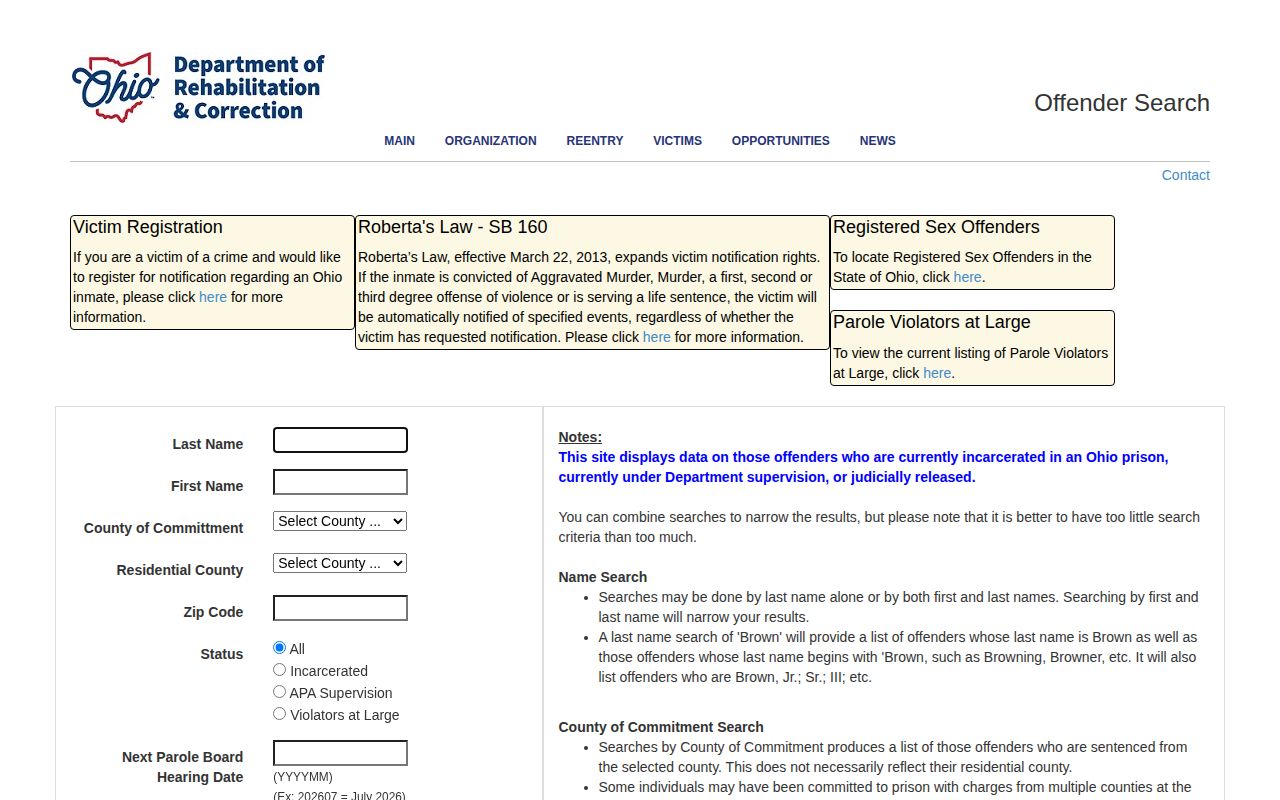
The statewide tool can search by status and committing county, but it is not a Holmes County Jail history.
Holmes County Release Credit Rules
ODRC explains that the expected date starts with the term imposed by the judge and is reduced by qualifying jail-time credit. ORC 2967.191 requires reduction of the prison term by confinement arising from the offense for which the person was convicted and sentenced, subject to the statutory process. The sentencing entry and ODRC computation should agree on credited days. A later correction can move the display.
For people confined on or after April 4, 2024, the current earned-credit law is ORC 2967.194. An eligible person may provisionally earn one or five days for each completed month of productive participation in qualifying education, vocational work, prison industry, treatment, or other constructive ODRC programming. ODRC records provisional credit and applies administrative review. Credit may be denied or withdrawn for rule violations.
The statute also addresses a limited completion award and a distinct completion or achievement credit. For a person not serving a mandatory term, offense-of-violence term, or sexually oriented-offense term, division (A)(3) can allow 90 days or a ten-percent reduction, whichever is less, for each listed qualifying achievement. Eligibility must be read from the current law and the sentence. It cannot be supplied by a generic calculator.
Ordinary participation and completion credit under divisions (A)(1) and (A)(2) has an aggregate cap of 15 percent of the stated prison term. Division (A)(3) is treated separately. Certain nonreducible terms and listed offense or sentence classes are excluded. The historical ORC 2967.193 regime should not be presented as the current universal rule after the newer statute took effect.
Ohio Administrative Code Rule 5120-2-06 addresses eligibility, provisional and final awards, withdrawal, and older sentence regimes. Ohio's major truth-in-sentencing change took effect on July 1, 1996. Modern definite terms generally replaced discretionary parole for most non-life felony sentences, while eligible life and legacy indeterminate terms can still reach parole review. That mixed group helps explain the combined ODRC date label.
Why Holmes County Release Dates Change
A date can change even when it was copied correctly. The cause must be tied to the sentence or custody record, not guessed. Some changes adjust the calculation. Others create a different lawful release path or require custody to continue elsewhere.
| Factor | Possible effect | Record to check |
|---|---|---|
| Corrected jail-time credit | Moves the computed term based on credited confinement | Sentencing entry and ODRC computation |
| Earned-credit award or withdrawal | Changes the eligible reduction under current law | ODRC sentence record |
| Concurrent or consecutive terms | Changes how multiple terms combine | Judgment and aggregate sentence |
| Judicial release | Creates a court-controlled community-supervision path | Court order and later ODRC status |
| Parole decision | Grants, denies, or continues consideration for an eligible term | Latest hearing result and official minutes |
| Indefinite-sentence review | May continue custody after a presumptive point within the lawful maximum | ODRC determination and sentence |
| Another case or hold | Can prevent community release or cause transfer | Court, jail, and receiving-agency records |
ORC 2967.271 governs qualifying non-life felony indefinite sentences. It distinguishes the minimum term, a presumptive earned-early-release point, reasons an administrative decision may continue confinement, and the maximum term. This is another reason a correctly displayed milestone may not become the final physical release date.
Judicial release under ORC 2929.20 can also create a different path. The sentencing court's order supplies authority, while the later ODRC status and supervision start show the state transition. A favorable order or review should be followed to the later custody record.
Holmes County Jail Date Computation
Holmes County publishes no local projected-date field and no public jail calculation policy. That negative finding determines the channel sweep. Start with the judgment entry, verify jail-time credit, ask Corrections for the existing sentence calculation or release record, and check any other case or hold. The Sheriff's Jail and Corrections page identifies the local operation, but it does not publish a calculator. Do not transfer the ODRC earned-credit formula to a definite county-jail sentence.
ORC 2947.151 permits a sheriff to reduce a definite jail term for a person whose conduct merits reduction, within the limits in the statute. The actual Holmes County calculation still depends on the sentence and jail administration. A court modification or corrected credit may matter as well.
The Holmes County Jail operates on weekends and holidays, but continuous operation does not establish a Friday adjustment, a set discharge hour, or a release door. No local source confirms any such rule. When the precise day matters, call Corrections at 330-674-5549 and identify the person and court case. Ask for the existing computation and whether any destination or receiving custodian is recorded. The Sheriff records-request policy supplies the documentary route when an oral status check is not enough.
This county-specific absence also means a court term should not be reduced with an unsourced web formula. Use the actual judgment and responsible record keeper. If the jail says custody transferred, follow the receiving system instead of reporting the county departure as community release.
Note: Holmes County's continuous jail operation is not evidence of a standard weekend, holiday, or Friday release schedule.
Holmes County Release Record Example
A public ODRC example tied to Holmes County illustrates why field context matters. The record shows a Holmes County docket, admission and sentence material, jail credit, the combined expected-release/parole-eligibility field, and a status of “RELEASED - Judicial Release.” The once-expected date and the later court-controlled release mechanism coexist in the same state history.
The public Holmes County ODRC detail example is captured in the mapped image.
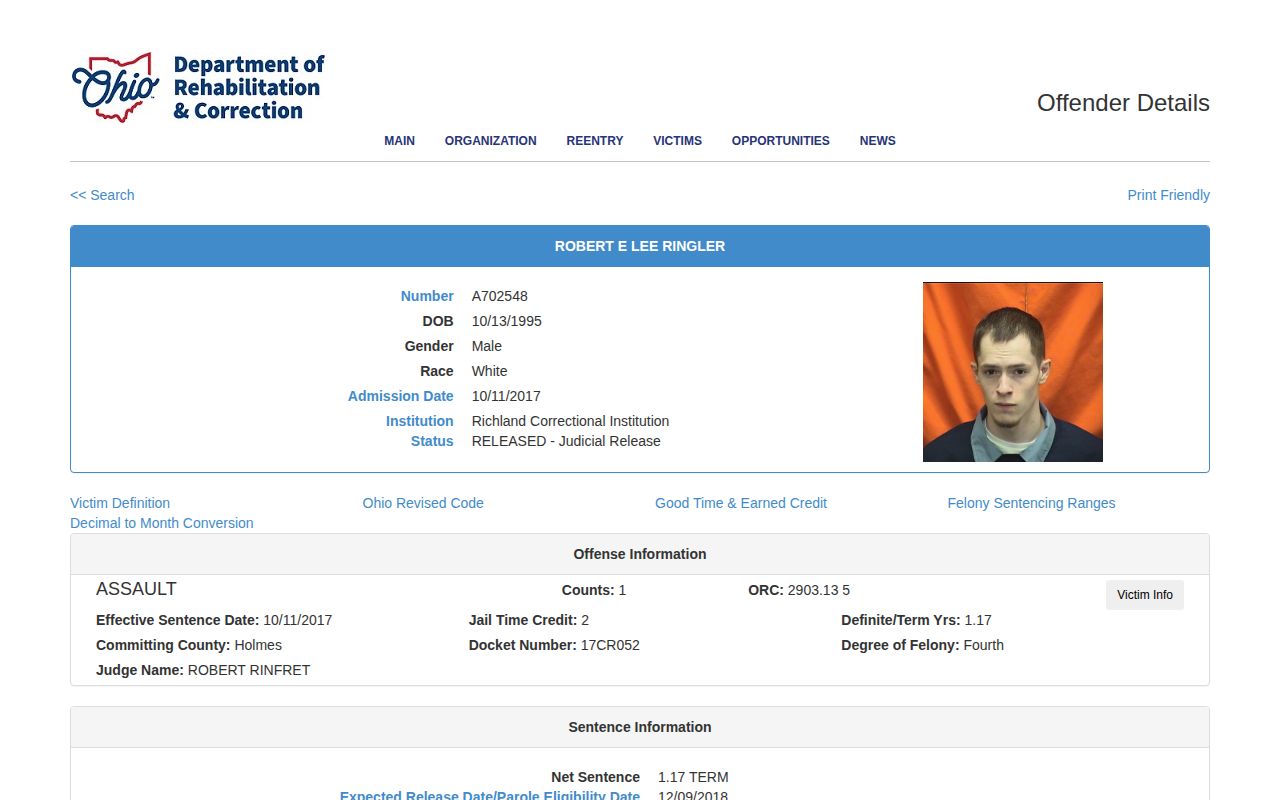
The useful lesson is structural, not personal: quote the date label, then read the later status, docket, sentence, and supervision fields before describing the outcome.
A public example should never be treated as a current Holmes County recent-release list. It demonstrates the ODRC interface and the difference between a projected point and an actual release mechanism. Each new lookup needs its own access date and identity check.
Confirm Holmes County Release Dates
A final check uses two sources. For a county sentence, pair the jail's date and disposition with the Holmes County court entry. For an Ohio prison sentence, pair the current ODRC status with sentence, hearing, or judicial-release context. If the sources conflict, describe the conflict and contact the record keeper rather than choosing the preferred answer.
For a pending custody change, Ohio VINE can send a reported event. Registration and limits are covered in the Holmes County VINE inmate check. The alert should still be verified through the Sheriff or ODRC because VINE data can lag and a transfer is not community release.
Use precise language. “Expected Release Date/Parole Eligibility Date” is a milestone. “Released - Judicial Release” names a mechanism in the state record. “APA Supervision” means the person is out of state incarceration under ODRC control. “Transferred” means custody continued with another agency. These distinctions prevent a valid date from being turned into an invalid claim about freedom from all custody or supervision.