
Holmes County Supervision Types
Holmes County Adult Probation and the ODRC Adult Parole Authority, or APA, serve different courts and sentences. Adult Probation handles community control or probation ordered by a local court. It also monitors some defendants released on bond while their cases are pending. APA handles qualifying people released from Ohio prison on parole, post-release control, or a related ODRC status. Leaving the Holmes County Jail does not by itself place a person in either group.
The first question is therefore not simply whether someone is “on paper.” It is which order controls. A Holmes County docket can show community control, a bond term, judicial release, or the end of a local case. ODRC Offender Search can show APA Supervision, supervision dates, the assigned APA office, or another state status. A probation entry is not proof of an ODRC term, while an old prison record does not prove supervision remains active today.
| Point | Probation | Parole or APA control |
|---|---|---|
| Authority | Holmes County court | ODRC Adult Parole Authority or Ohio Parole Board |
| Common public source | Holmes County docket and Adult Probation | ODRC Offender Search detail record |
| Custody history | May follow jail, a community sentence, or monitored bond | Follows release from state incarceration or a state supervision status |
| Useful end marker | Court entry terminating community control | Supervision End Date/Early Termination or confirmed expiration |
- Community control or probation
- A local court order that permits a person to remain in the community under stated terms.
- Parole
- Release from an eligible indeterminate prison term under state supervision and Parole Board authority.
- Post-release control
- ODRC supervision that follows certain prison terms under Ohio law.
- Discharge
- The recorded end of the identified custody or supervision duty, not merely release from a building.
Verify Holmes County Post-Release Supervision
A sound Holmes County supervision check starts with the case and then follows the agency named by the record. Names can collide, and one person can have more than one case. Match the person with a case number, ODRC number, offense, and committing county where those facts are public. The exact status matters more than a loose claim that someone is “on parole.”
- Search the Holmes County court docket. Read the controlling order for community control, monitored bond, judicial release, termination, or a warrant.
- If the record reflects local supervision, confirm procedure with Holmes County Adult Probation. Public access may not include all supervision material.
- If an Ohio prison term appears, open ODRC Offender Search. Search by name or ODRC number and use the APA Supervision status filter when appropriate.
- On the ODRC detail page, compare the Holmes committing county and docket, status, supervision start, period or expiration, end or early-termination field, residential county, and APA office.
- Ask the named office to clarify current status when the public record is incomplete, old, or conflicts with the court file.
A Residential County filter can help locate an APA record linked to Holmes County. ODRC states that the displayed address is the last recorded address, not a promise of current location. The same caution applies when a period of supervision belongs to an earlier offense. Check which conviction and docket the supervision fields actually describe.
For the broader release trail before supervision began, the Holmes County released-inmate search and record path explains how the jail event, court order, and receiving system fit together.
Note: A supervision start date supports a transition from prison custody, but it does not replace the release event or court record.
Holmes County Supervision Contacts
The correct office depends on the order. Local community control and qualifying bond monitoring route to Holmes County Adult Probation. A public ODRC record in APA Supervision should name the responsible APA office. Central Records is the state fallback for older or incomplete public data, but it is not the local probation office.
Holmes County Adult Probation
Dominic Palmucci
1 East Jackson Street, Suite 102
Millersburg, OH 44654
Phone: 330-674-1121
Fax: 330-674-2761
Monday through Friday, 8:30 a.m. to 4:30 p.m.
ODRC Central Records
Ohio Department of Rehabilitation and Correction
Attn: Central Records
P.O. Box 430
Columbus, OH 43216
Use when the public offender record cannot resolve a state record question.
The local office can explain its procedure within lawful disclosure limits. Ohio public-record law has exceptions for some probation and parole material, so the presence of a public status field does not make a complete case-management file open. Ask a precise question about the public record rather than requesting private supervision notes.
The official probation overview also identifies presentence and expungement investigations among the office's work. Those duties do not convert every person it handles into a released state prisoner. They show why the court order should lead the search.
Holmes County Supervision Conditions
Conditions are the rules attached to a specific release or court order. They can include reporting, obeying the law, approved residence or travel, programs, and other case-based duties. The controlling judgment, Parole Board minutes, or supervision document is the source. A general summary should never be treated as the full set of terms for one person.
ODRC's standard Conditions of Supervision direct a person to report to the supervising officer by the next business day after release from custody. That fact helps with release planning, but it does not establish that a given person reported. Nor does a public record disclose each contact with an officer.
A claimed violation does not erase the earlier release. It may lead to a warrant, hearing, changed terms, or renewed custody depending on the responsible system. For a local probation matter, inspect the Holmes County docket for filed warrants or court action. For APA supervision, compare the current ODRC status and the state violator path. A new jail or prison record may show that custody resumed.
Holmes County Absconder Safety
An absconder is a person alleged to have stopped complying with required supervision contact or location rules. ODRC's Parole Violators at Large list is a public lead for alleged APA absconders. It is not a command for a member of the public to act, and it does not prove what happened after the page was last updated.
The state explicitly tells law enforcement to verify a warrant through LEADS or NCIC before an arrest. A residence shown in the offender system is also the last recorded address and may be stale. Do not approach, follow, detain, or confront a listed person. Report an immediate safety threat to 911. Other current concerns go to the proper law-enforcement agency.
The manifest capture of the ODRC violators-at-large screen shows the public state route used for this limited check.
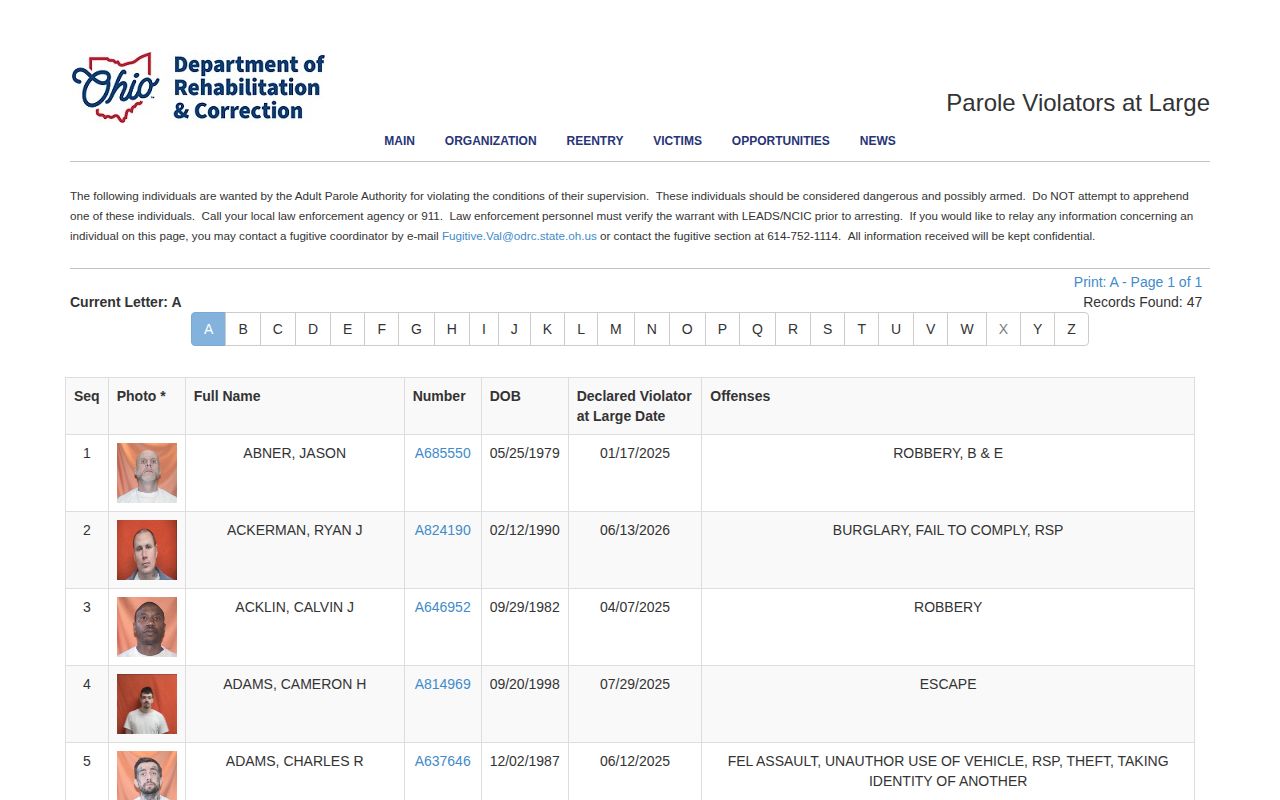
The screen is a starting point only. Current warrant verification belongs to law enforcement, while custody status should be checked in the responsible agency record.
Note: A violator-at-large listing signals alleged later conduct; it does not mean the prior Holmes County release never occurred.
Holmes County Supervision Discharge
Release from jail or prison and discharge from supervision are separate events. ODRC defines Expiration of Supervision Term as the maximum period set by the governing entry, statute, or Parole Board minutes. A Supervision End Date/Early Termination can record an earlier end after objectives and conditions were fulfilled. Neither field should be reported as the day the person walked out of prison.
For Holmes County probation, use the court docket to find an entry ending community control, closing the case, or changing the order. A missed public field is not enough to claim discharge. The office may confirm procedure, but some case material can remain nonpublic. In an APA case, save the exact ODRC status and dates with an access date because dynamic records can change.
A discharge from one case also does not resolve another case, hold, or supervision term. Compare identifiers and dates before drawing a conclusion. Clear language matters: “released from incarceration under APA supervision” differs from “discharged from APA supervision.”
Holmes County Release Reentry Support
The Wayne-Holmes Reentry Coalition is listed as an ODRC-certified nonprofit serving people returning to Wayne and Holmes Counties. Its listing describes release-planning coordination, support groups twice each month, no charge, and a contact number of 330-264-9597.
This local resource helps with the move back into the community. It is not a custody-status source, probation office, APA office, or court. A coalition contact cannot replace the ODRC record, a Holmes County order, or confirmation from the supervising office. Keep the roles separate so support needs and record verification both reach the right place.
The local layer is useful because supervision may begin quickly after release. ODRC's standard terms call for prompt officer reporting, while a local court can set its own reporting direction. Release planning should follow the actual order and assigned office, not a general expectation based on another person's case.
Holmes County Release Property Claims
The Holmes County Sheriff's Evidence/Property Division has detailed rules for evidence and safekeeping property. Those rules must not be confused with routine personal effects returned during jail discharge. Research found no published local process for ordinary jail property at release.
For evidence or safekeeping property, the Sheriff's divisions page lists appointments Monday through Thursday from 8:00 a.m. to 4:00 p.m., at least 24 hours of notice, valid identification, and a Holmes County case number. Evidence may also need written release from a court, officer, or detective. Pam Akins can be reached through the Sheriff's main number, 330-674-1936.
Found or safekeeping property is held for 90 days before disposition or auction. A victim or defendant in a closed case may file a claim, and review can take up to three weeks. These steps concern a distinct evidence function. They do not prove when custody ended, whether supervision began, or what property was handed back at the jail.